
From the Archives: Johann Christian Fischer
Freiburg 1733 - London, 29 April 1800,
Oboist, and composer of instrumental, orchestral and pedagogical works
Initially starting his musical life studying the violin Fischer turned to the oboe. In 1760 he was part of the band (in Dresden) at the court of Augustus III King of Poland. On its dissolution in 1764 Fischer joined the court (in Berlin) of Frederick the Great, apparently accompanying the flautist Frederick for several hours a day. Following further travels around Europe with great success, he gave his first concert in London on 2 June 1768, a concert which included a performance on the new “piano” by John Christian Bach; Fischer was to settle in Britain from 1774. In London he was a member of Queen Charlotte’s private band at Buckingham House although only formally a member from 1780.
Fischer was a friend of the artist Thomas Gainsborough (1727-1788) and in February 1780 married the artist’s daughter Mary (b.1750), although he flirted with her slightly older sister Margaret. Apparently the marriage only lasted a several months but we see that his RSM application records him as a married man. There is a painting of Fischer by Gainsborough, dating from the year 1780, held in the Royal Collections.
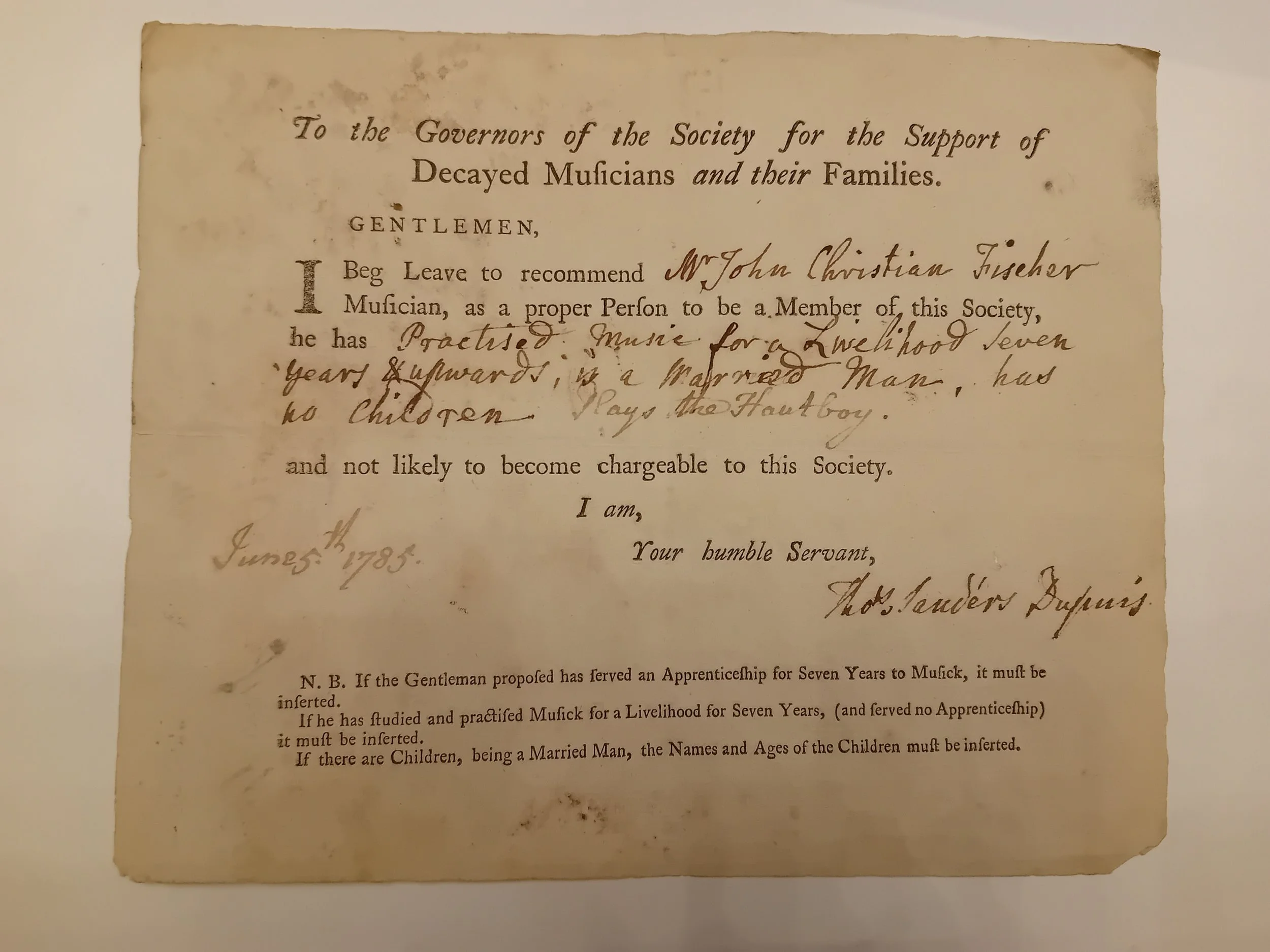
Membership application, 1785
He joined the RSM on 2 October 1785. The previous year he had been one of the four principal oboists at the Handel Commemoration Concerts, the other three being ‘Mr Vincent’ (most likely a relation of one of the RSM’s founder members, Thomas having died in 1783), Philip Eiffert (d.1792), and William Thomas Parke (1761-1847). These last two members, the Westminster Abbey concerts, and George III’s patronage of the festival and interest in the Society of Musicians, must have endorsed Fischer’s reasons for applying.
Fischer’s proposer to the RSM was Thomas Dupuis (1733-1796), organist at the Chapel Royal from 1779:
5 June “Mr. Dupuis proposed Mr. John Christian Fischer as a proper person to be a Member of this Society”, with his election on 3 July: “Mr. John Christian Fischer was Baloted for, and Unanimously Elected”.
On 2 October 1785 “Mr. Dupuis Signed the Book of Admission for Mr. John Christian Fisher, and paid his Subscription.”
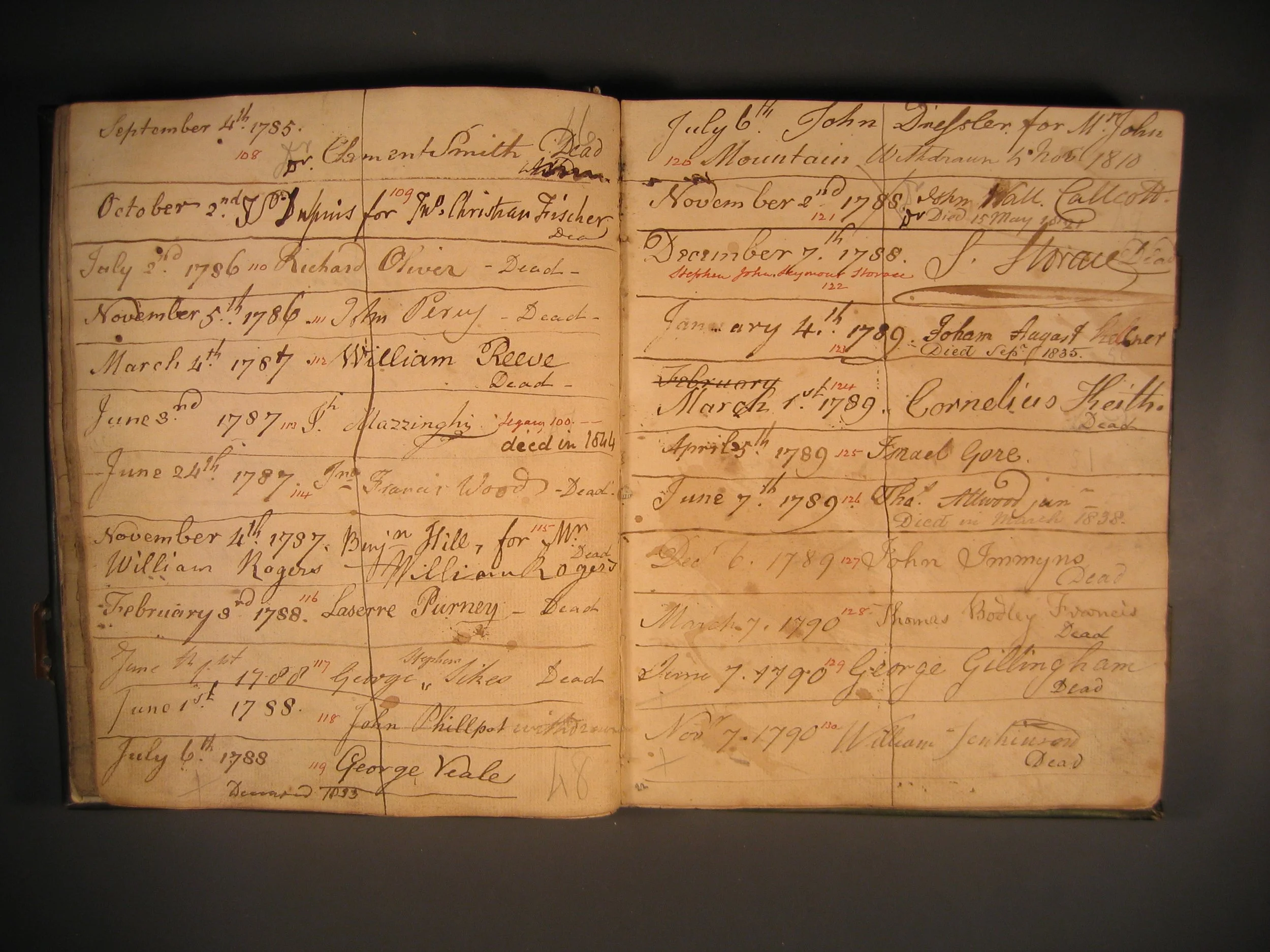
In 1788 “A Letter was Ordered to be sent to Mr. Fischer informing that he is in Arrears to the Society” (2 March) but this was presumably remedied as he is then documented on 3 November 1799 and 5 January 1800 as being one of the Governors at these dates.
Doane’s A Musical Directory of 1794 lists him as living at no.40 Dean Street in Soho.
W.T. Parke, as mentioned above, noted the death of Fischer in his Musical Memoirs, comprising an account of the general state of music in England (Henry Colburn and Richard Bentley, 1830): “Fischer, the celebrated oboe player, died in the early part of this year. He was seized with apoplexy whilst performing in a concert at Buckingham House, in the presence of their Majesties, and fell on the double bass instrument of the musician next to him” (vol.I, p.334).
An amusing anecdote was related by Michael Kelly in Reminiscences of Michael Kelly of the King's Theatre and Theatre Royal Drury Lane (Henry Colburn, 1826):
“Fischer, the great oboe player, whose minuet was then all the rage; he was a man of singular disposition, and great professional pride. Being very much pressed by a nobleman to sup with him after the opera, he declined the invitation, saying, that he was usually very much fatigued, and made it a rule never to go out after the evening's performance. The noble lord would, however, take no denial, and assured Fischer that he did not ask him professionally, but merely for the gratification of his society and conversation. Thus urged and encouraged, he went; he had not, however, been many minutes in the house of the persistent nobleman, before his lordship approached him, and said, " I hope, Mr. Fischer, you have brought your oboe in your pocket." — " No, my Lord", said Fischer, "my oboe never sups." He turned on his heel, and instantly left the house, and no persuasion could ever induce him to return to it”.