
From the Archives: John Francis Prina
(London, 5 August 1798 – London, 31 August 1841)
John Prina appears to have eluded any standard biographical dictionaries apart from The Royal Society of Musicians of Great Britain List of Members, 1738-1984. He was a singer, organist, pianist, violinist, and composer and arranger. His application paper to join RSM records that he was “in the Choir of the Portuguese Ambassador, under Mr Novello, is Organist of Hampstead Chapel, performs on the Piano Forte and Violin, and has considerable private teaching”; his recommenders were the aforementioned Vincent Novello (1781-1861), the pianist and composer of two piano concertos George Eugene Griffin (1781-1863) and Richard Hatton (1804-1879).
Despite his apparent early business, good connections, and extensive working pattern, it seems that when he died at the early age of 43 years, he left a destitute widow, Mary Ann [née Healey]. She immediately wrote to RSM for financial help to cover the funeral costs, and for ongoing monthly assistance. Prina’s file further reveals an extensive path of sad neglect and decay with the widow moving from lodging to lodging and workhouse, sometimes to evade creditors, as well as highlighting a path reliant on alcohol misuse with testimonies from angry landladies and others. She appears to have died in early 1854.
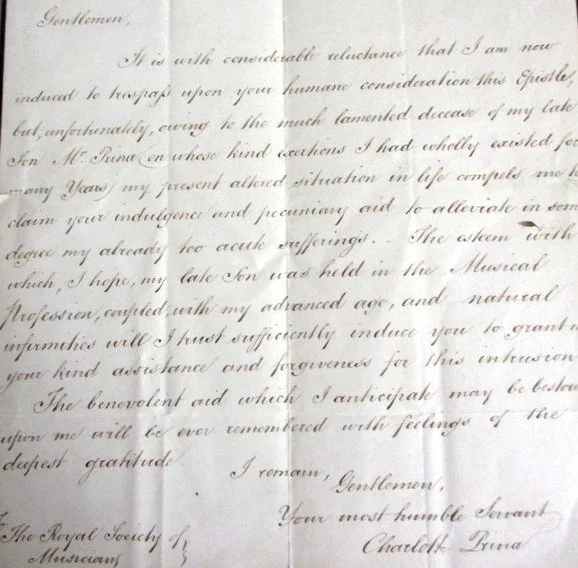
The archive recently received, from a donor, a letter from Prina’s mother Charlotte. Dated 14 December 1841, just three months after her son’s death, she also writes to RSM in the most effusively turgid tone seeking financial assistance.
In addition to a handful of extant publications comprising famous tunes or arias from operas, arranged with variations for piano or harp, Prina composed the following:
The celebrated Euterpeon waltz, as performed by the above instrument arranged for the piano forte by Signor Prina (J. Duff & Co., 1833).
The Euterpeon, essentially an early musical box with orchestral effects, and which generally played several tunes, was exhibited at the Gothic Hall, 7 Haymarket (Opposite the Italian Opera House) and visitors paid a shilling (children half price) to hear and see the spectacle. Prina’s arrangement of a Waltz, for the domestic market to play on the piano, is an interesting direction for the music to travel – most popular tunes were likely to be arranged for a musical box.