
From the Archives: Carl Maria Friedrich Ernst von Weber
(Eutin, 19 [?] November, 1786 – London, 5 June, 1826): On the 200th anniversary of the death of the conductor, pianist and composer.
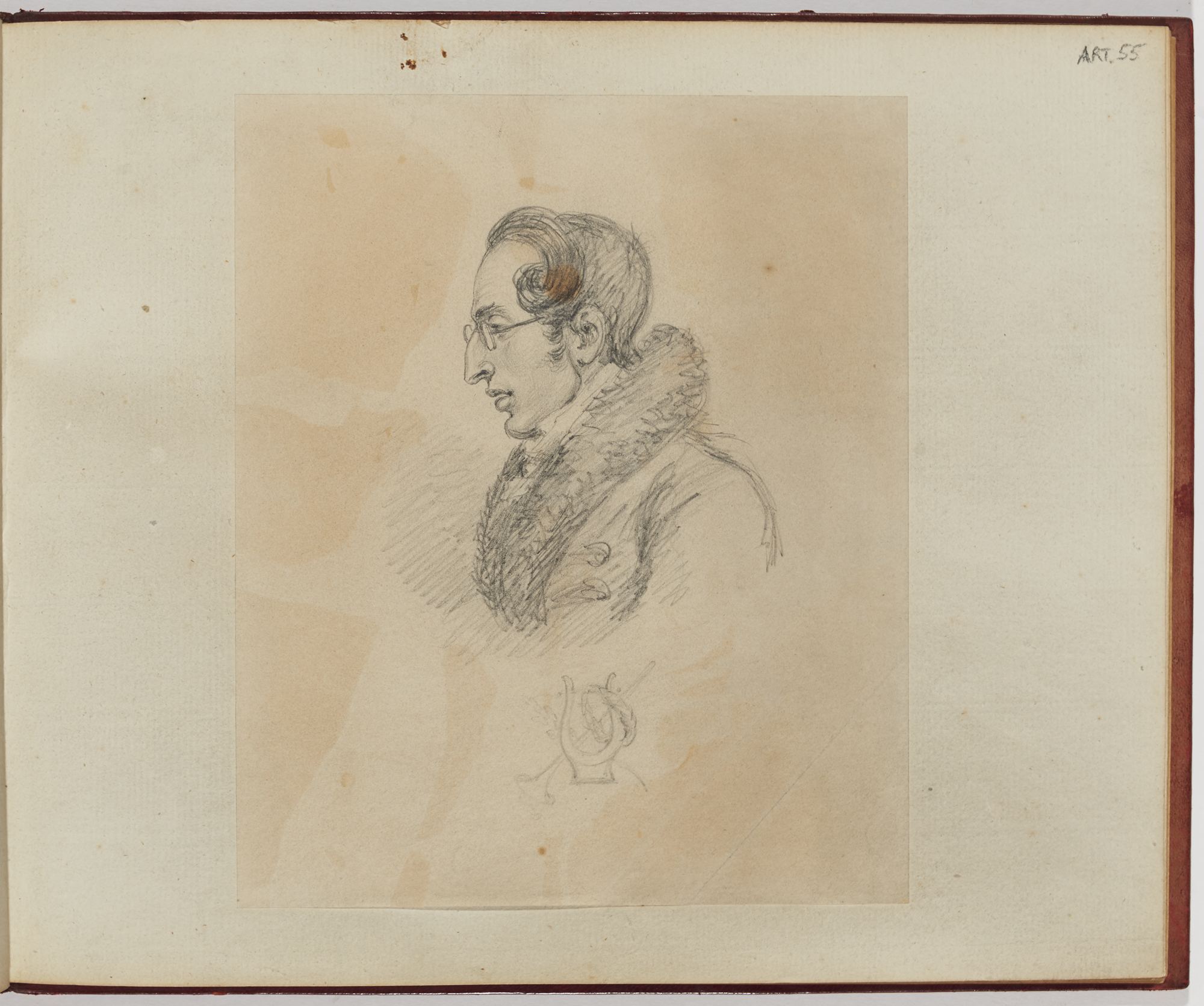
Pencil drawing by an unidentified artist; [1826]. Donated by Lady Cusins in 1906.
The success of Weber’s operas, especially Der Freischütz in 1821, made him an international celebrity, and his musical legacy stretched across many famous names of the middle of the century, namely, Mendelssohn, Wagner, Meyerbeer and Berlioz. Der Freischütz led to performance and compositional offers from Paris and London, and finally to the significant commission of his opera Oberon. Charles Kemble (1775-1854), the theatre impresario, intended a commission for the season of 1825 but the opera was postponed to the following year. Weber had been learning the English language and realised that more work was needed for him to fully realise the libretto.
On 27 January 1826 the conductor Sir George Smart wrote to the composer Weber. Near the end of the letter he finishes off: “I am delighted that you intend to honour me with becoming my guest, pray tell Mrs Weber that I shall take every care of you, there shall be a pianoforte in your room for your exclusive use … Shall you bring a servant with you? I do not think you will want one in London for I have two very good ones, and we can find plenty of persons who will walk about London and be happy in that pleasure with you”. Weber’s travelling companion from the continent was the flautist Anton Bernhard Fürstenau (1792-1852).
During his time in London Weber conducted performances of his opera Oberon at the Theatre Royal in Covent Garden (12 April onwards), private events, a performance at the Philharmonic Society’s concert (3 April), as well as a benefit concert for himself (26 May) and a concert for the RSM (13 May).
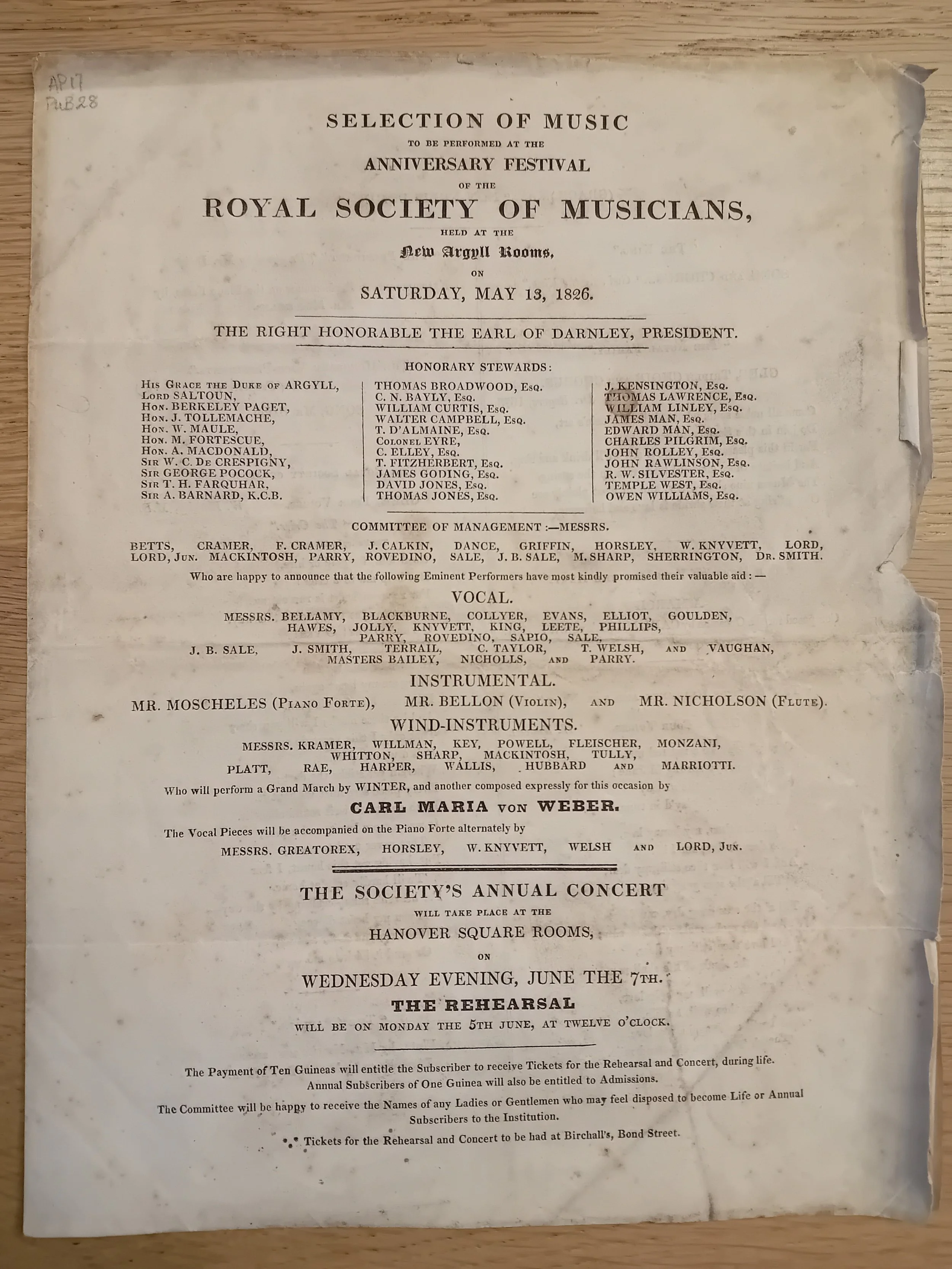
The concert was held at the New Argyll Rooms, just along from Oxford Circus, and thus a short walk from Sir George Smart’s home in Great Portland Street. The programme, printed by George Woodfall (1767-1844), includes lists of the stewards and performers, and a statement of the RSM’s financial accounts for the previous year. The concert included the first performance of a March which Weber had written for the Society for this occasion.
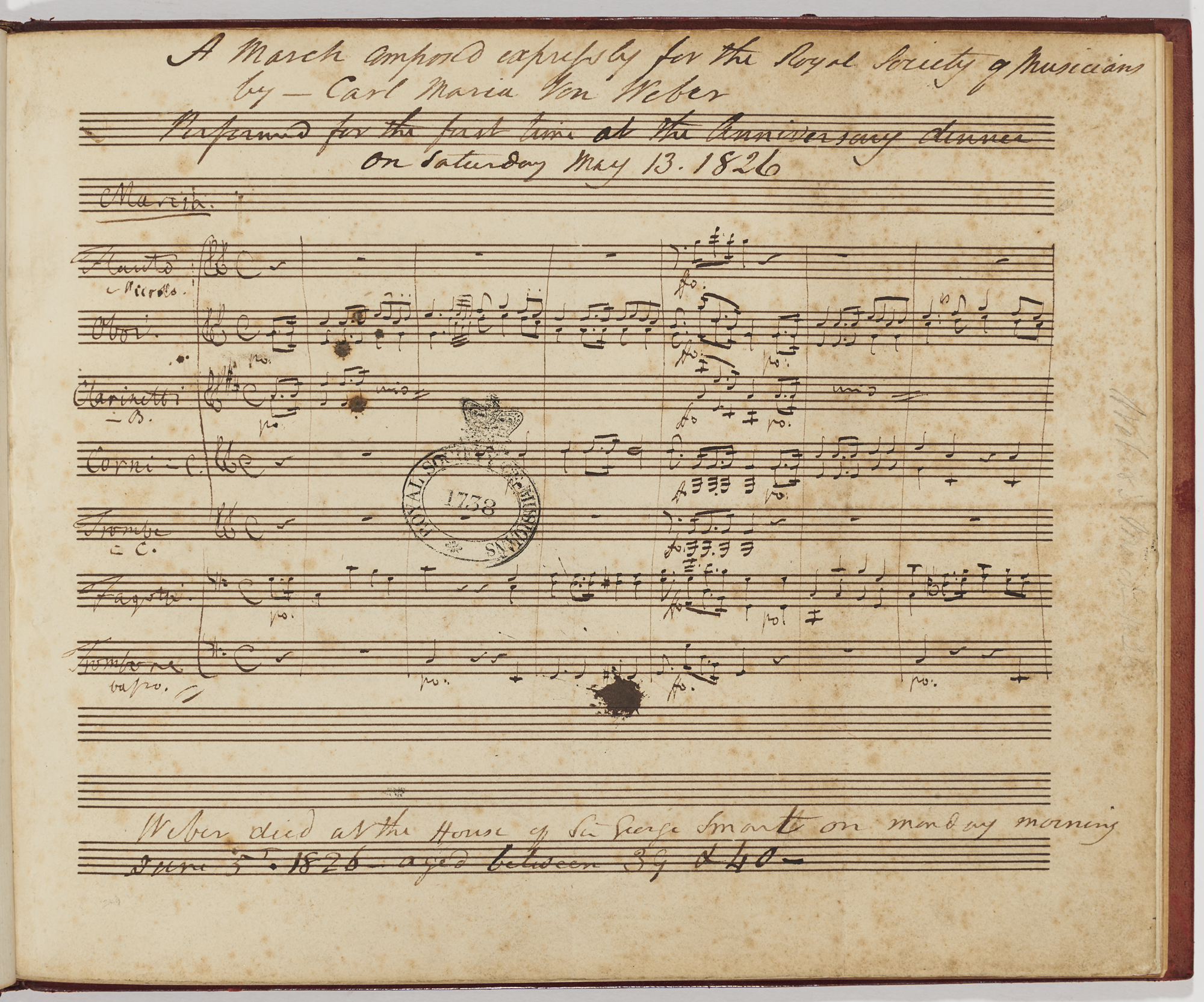
A march composed expressly for the Royal Society of Musicians by Carl Maria Von Weber ; performed for the first time at the anniversary dinner on Saturday May 13, 1826
Sadly, just three weeks later, and three months after his arrival in London on 5 March, Weber died in Sir George’s home at no.91 Great Portland Street, following lengthy problems with tuberculosis. His funeral took place on 21 June at St Mary Moorfields; his remains were moved to Dresden in 1844.