
From the Archives: Carl Hintze and the ‘Deutsches Hospital’
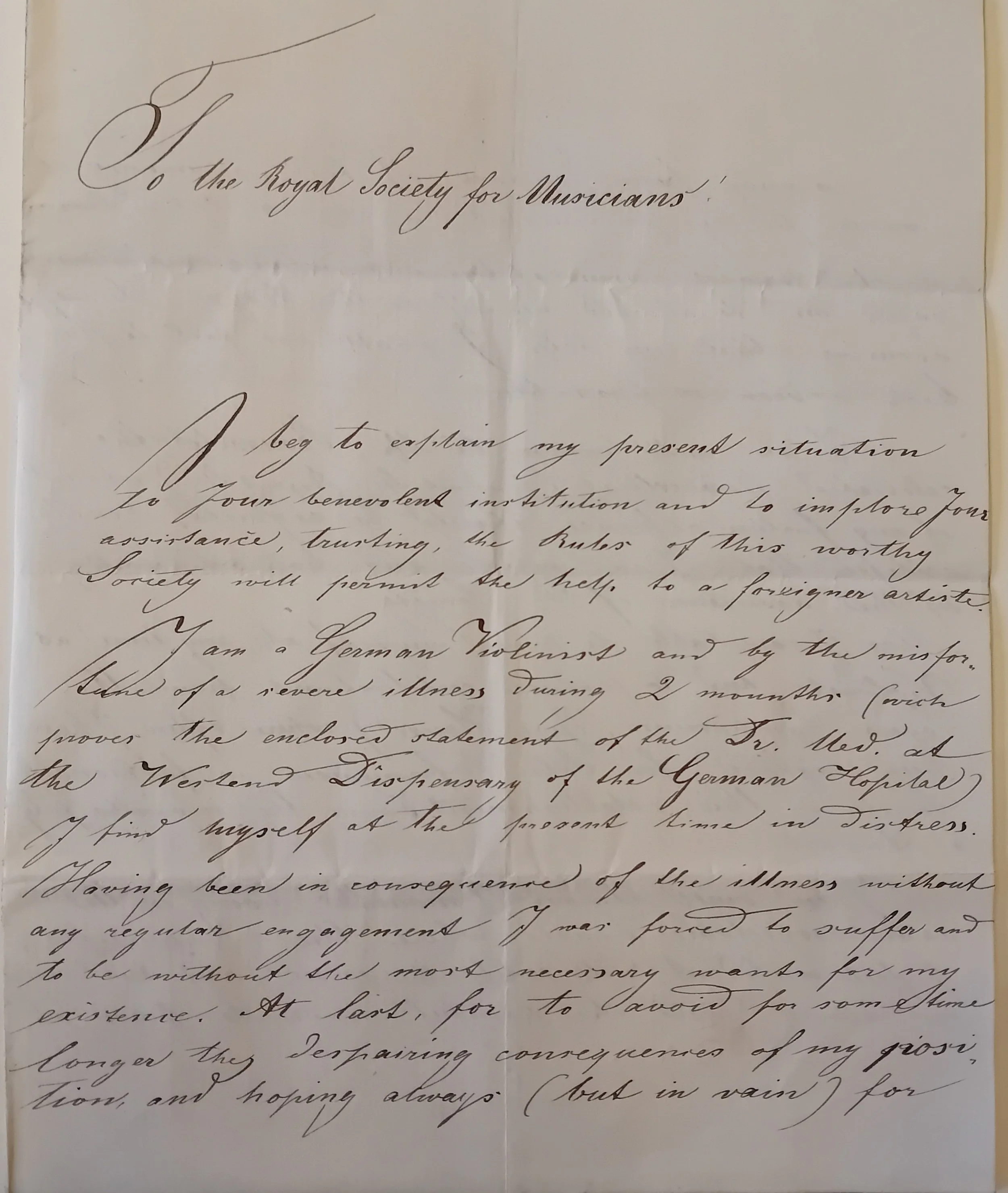
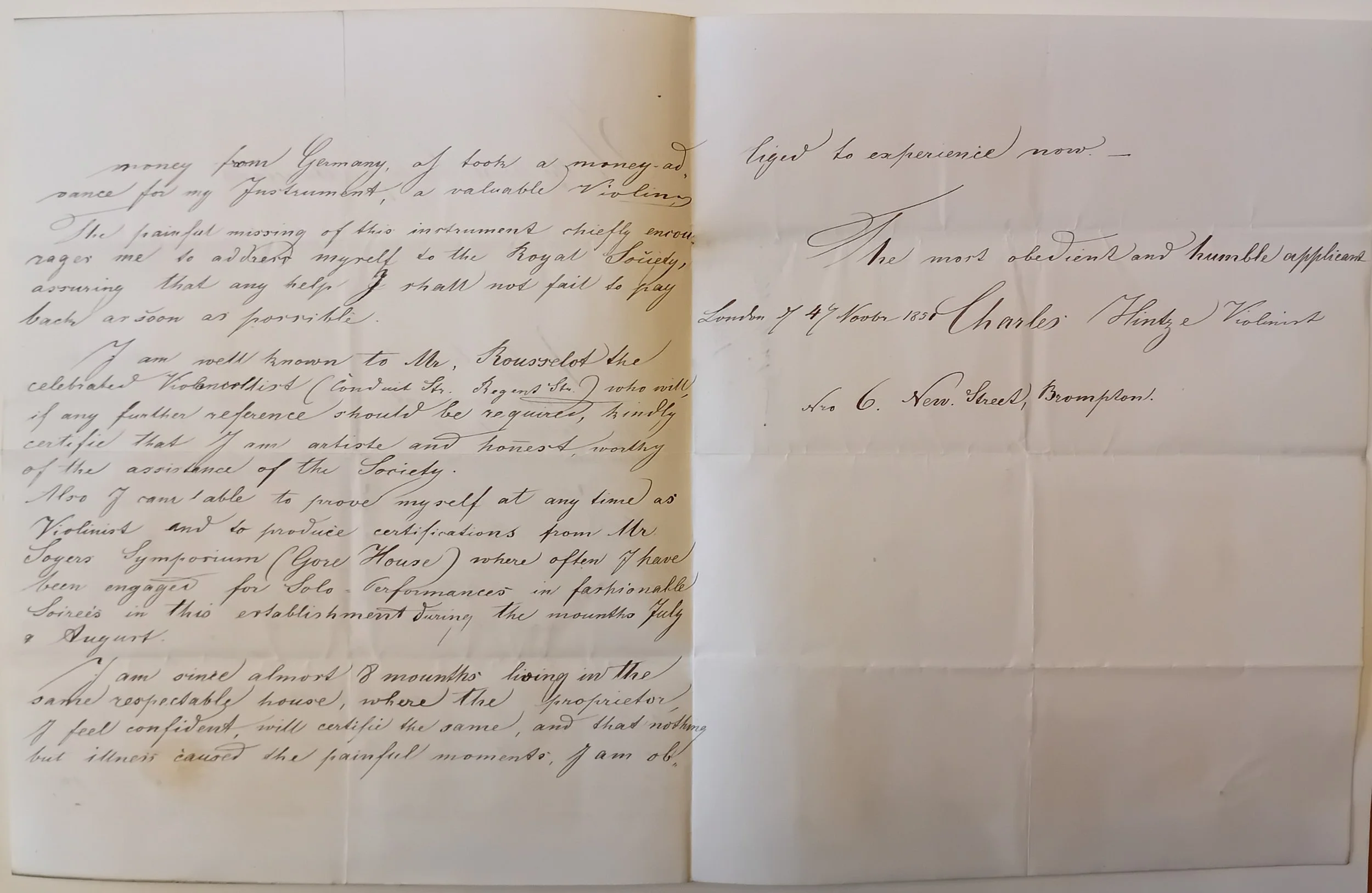
This note was found in files of correspondence from 1851, and was attached to a request for support from a self-described “foreigner artiste” Charles (Carl) Hintze. Carl had recently arrived from Germany, seeking new employment opportunities in London; he references performing at ‘fashionable soirées’ at Gore House, a restaurant run by the French chef Alexis Soyer (1810-1858), and also that the musician Scipion Rousselot (1804-ca 1880), the cellist in the Beethoven Quartet Society at this period, would also vouch for him. Hintze was tragically struck down with illness shortly after his arrival. Although not a member of RSM, he was recommended by acquaintances to apply to the Society for financial aid. As with many similar requests, Hintze proactively sought a doctor’s note to confirm invalidity, to better help his case.
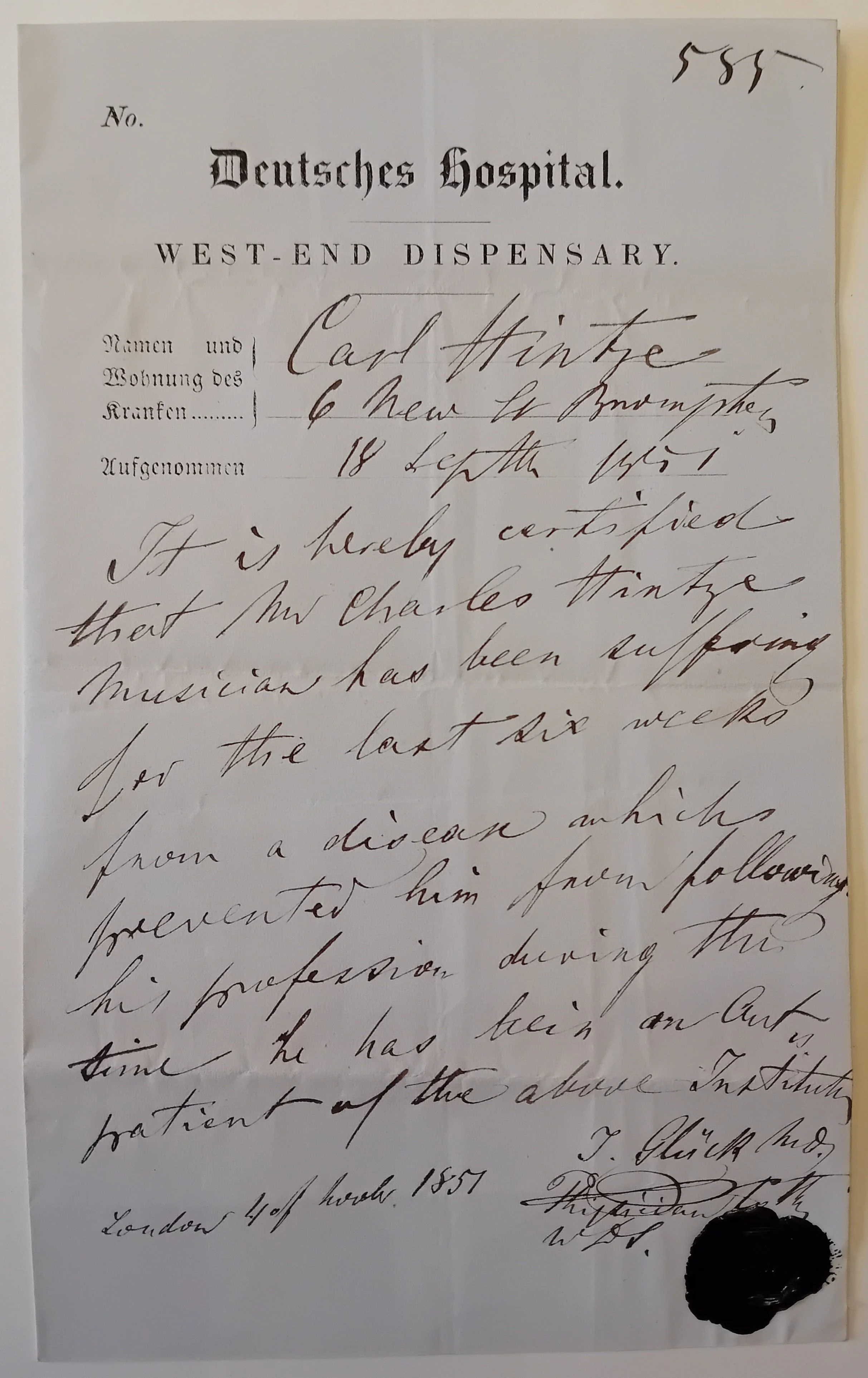
The note was written by a ‘Dr T Glück’, his name clearly visible in both his signature and his black wax seal. His letter, dated 18 September 1851, notes that “it is hereby certified that Mr Charles Hintze musician has been suffering for the last six weeks from a disease which prevented him from following his profession” and that “he has been an outpatient of the above institution”. At the top of the note sits the neatly printed moniker of the institution, “Deutsches Hospital. West-End Dispensary” which had recently opened in October 1845.
Although the note is written in English, presumably to assist with the ease of corresponding with the (mostly) English RSM Governors the truthfulness of Hintze’s invalidity, the form’s pre-printed information boxes are written in German – “Namen und Wohnung Des” Name and Address, “Kranken” Illness, “Aufgenommen” Record (Date) – reflecting the inherent ‘German-ness’ of this institution.
During the eighteenth and nineteenth centuries, London became dotted with these ‘specialist’ hospitals, created by immigrants and members of their communities seeking to support themselves in this ‘foreign land’. Another example was what became known as ‘The Jews Hospital’, an institution created in 1807 when a group of Spanish and Portuguese Jews donated funds to build a place for their specialist community. The Hospital had two departments, one to care for the old, and the other to teach children useful trades like furniture making or knitting. Similarly ‘The French Hospital’, affectionately known as La Providence from the 1720s, had been founded to support poor French Protestant (Huguenot) immigrants and their descendants in London.
Possibly inspired by these two examples, The German Hospital (Deutsches Hospital) was founded by German philanthropists and businessmen in Dalston, East London. Its aim was to provide free medical care for the city’s German-speaking population, particularly poorer immigrants; located on Ritson Road, it operated for over 140 years, initially as a general hospital.
The Deutsches Hospital’s main claim to fame is the allegation that the nursing care provided by the Protestant Deaconesses inspired Florence Nightingale to visit the hospital twice, including in 1851, before undertaking three months of training at the parent Institute for Protestant Deaconesses in Kaiserwerth, Germany. It is also possible that Florence Nightingale and Charles Hintze may have crossed paths during his treatment at the Hospital that year. Nightingale is known to have worked in Crimea with Hintze’s previous employer Alexis Soyer – this letter provides an intriguing connection between these two well-known characters.